Turn grids into contours — several times faster.
isosweep extracts closed, hill/hole-classified contour lines from DEMs, weather models, dose maps and any 2D grid 3.8–12× faster than the fastest single-threaded open-source engine, measured head-to-head on the same data against GDAL, VTK, ContourPy and scikit-image. Filled contour bands come out as OGC-valid polygons from the same engine.
Background: real isosweep output, 144 contour levels (every 25 m) from a Copernicus 30 m DEM of the Bernese Alps.
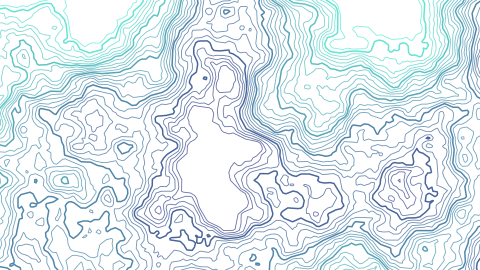
Terrain & bathymetry contours
DEM, LiDAR and bathymetry rasters to contour lines — on real Copernicus and GMRT data, against GDAL, VTK and ContourPy.
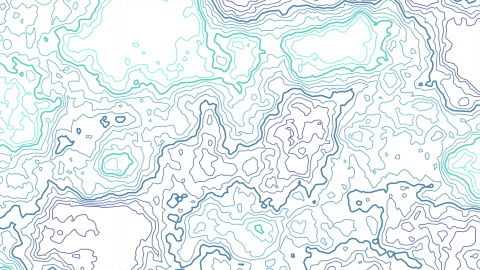
Web-map contour tiles
Contour vector tiles generated per request from an elevation source, instead of pre-generating 100+ GB per contour style.
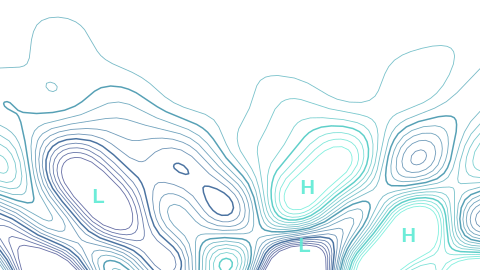
Weather & climate charts
Isobars, isotherms and isohyets for every forecast cycle, measured on real NOAA GFS and HRRR model output.
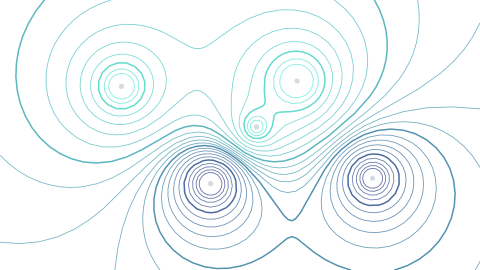
Scientific Python
numpy-native contour lines for notebooks, dashboards and pipelines, compared with matplotlib, ContourPy (serial and threaded) and scikit-image.
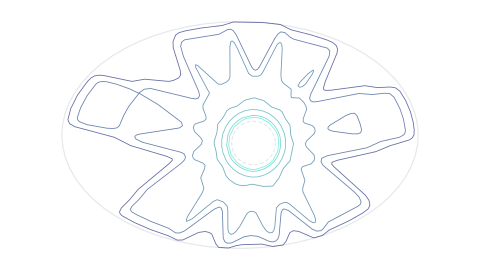
Medical imaging
Isodose lines, organ and vessel boundaries, interactive threshold scrubbing — on CPU-only clinical hardware.
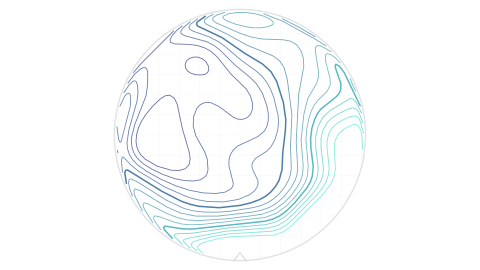
Semiconductor & metrology
Wafer maps, OPC PV bands, contact/via arrays and log-scale doping profiles — thousands of closed rings, classified in one pass.
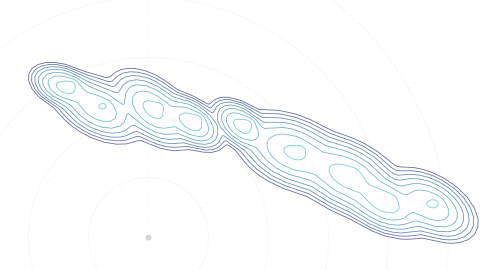
Real-time & embedded
Fog of war, live sensor fields, moving-map terrain and instrument displays, re-contoured every frame on one CPU core.
All levels, one pass
A patent-pending sweep finds every contour level in a single traversal. Its cost follows the length of the contours it emits, not cells × levels, so fine contour intervals stay cheap.
Finished topology
Curves come out ordered and closed, and each closed curve is classified from the field as enclosing higher or lower values. There is no stitching or ring-assembly pass to pay for afterwards.
Small, portable C
A C library with no third-party dependencies, a numpy-native Python package and a streaming command-line tool. It runs in servers, desktop apps and devices, and on rasters larger than RAM.
Same data, every library at its best
Identical grids and levels for every tool, each in its fastest documented configuration, multi-threaded modes and GDAL's unreleased code included. Only the contouring call is timed.
Dedicated hardware
A bare-metal server with fixed clocks, 30 timed rounds per configuration in random order, and real third-party data wherever it exists.
Audited, reproducible
Every figure on this site is checked against the raw samples, with a confidence interval for every speed-up. The harness is public on GitHub, so anyone can rerun it.
Evaluate it on your data
30 days with the SDK, the CLI and the exact harness behind these numbers. If it isn't clearly faster on your workload, we'll tell you.
Benchmarks measured November 2026 on a dedicated bare-metal server.