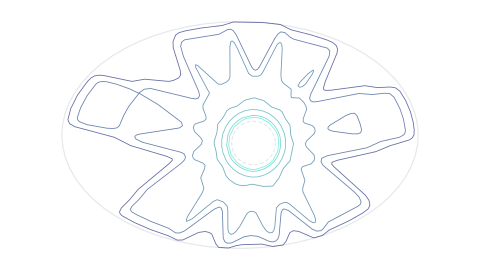
The problem
Isodose lines are re-drawn every time a planner moves a beam, changes a weight or scrolls through slices. Boundary contours of thresholded scans (vessels, lesions, implants) are re-extracted every time the threshold changes. Research tools run on VTK (3D Slicer) or scikit-image. Commercial planning systems use in-house code, which you can’t benchmark but can replace. Either way the contour step sits in the interactive loop, often on CPU-only clinical workstations.
Head-to-head
| Dataset | Grid · levels | isosweep1 thread | isosweep4 threads | scikit-image find_contours1 thread | VTK Flying Edges1 thread | ContourPy1 thread | GDAL 3.14-dev1 thread | VTK Flying Edges4 threads | ContourPy8 threads | Speed-upvs fastest 1-thread | Speed-upvs fastest overall |
|---|---|---|---|---|---|---|---|---|---|---|---|
| Adaptive RT isodose display | 512 × 512 · 16 levels (interval 1/16) | 1.00 ms | 0.67 ms | 30.5 ms | 9.92 ms | 16.9 ms | 7.44 ms | 4.95 ms | 7.72 ms | 7.4× | 7.4× |
| Vascular network segmentation | 1,024 × 1,024 · 10 | 2.64 ms | 1.11 ms | 73.2 ms | 23.9 ms | 42.8 ms | 23.6 ms | 6.72 ms | 9.77 ms | 9.0× | 6.0× |
Median wall-clock time per full extraction, in-process, identical in-memory grid and iso-levels for every tool, each in its fastest documented configuration; lower is better. All line tools return assembled polylines. "Fastest overall" compares our best (1 or 4 threads) with the best result of any other library at any thread count; the shaded cell is that library. Measured November 2026 on Intel(R) Xeon(R) Platinum 8488C (48 cores / 96 threads) — AWS EC2 c7i.metal-24xl (dedicated bare-metal server, no hypervisor); Linux-7.0.0-1018-aws-x86_64-with-glibc2.39; turbo disabled; governor performance; THP never. Methodology.
Exact configuration of each library
- scikit-image find_contours — variant per_level {}
- VTK Flying Edges (1 thread) — vtkImageData + filter pipeline built in prepare (zero-copy wrap, O(1)). vtkStripper joins segments into polylines (required for like-for-like output; MaximumLength unlimited so lines are fully joined) and is timed. variant sequential {"backend": "Sequential", "threads": 1}
- ContourPy (serial) — variant serial_reused {"name": "serial", "line_type": "LineType.ChunkCombinedOffset", "reuse_generator": true}
- GDAL 3.14-dev (master) — Both versions built from source with identical options. callback = pure computation, points copied into a result buffer (as any caller must); generate_ex = native API into an in-memory layer (native result type), the layer reset before each call outside the clock. Published value = faster of the two. variant generate_ex {"api": "GDALContourGenerateEx (in-memory layer)"}
- VTK Flying Edges (best SMP backend × threads) — vtkImageData + filter pipeline built in prepare (zero-copy wrap, O(1)). vtkStripper joins segments into polylines (required for like-for-like output; MaximumLength unlimited so lines are fully joined) and is timed. variant smp {"backend": "STDThread", "threads": 4}
- ContourPy (threaded, best threads × chunks) — variant threaded_reused {"name": "threaded", "line_type": "LineType.ChunkCombinedOffset", "thread_count": 8, "chunk_count": [4, 4], "reuse_generator": true}
Built for regulated software
- Repeatable. The same input and settings give identical output, run after run, which keeps verification and regression testing simple.
- No third-party dependencies. A C11 library: no runtime, no GPU driver, no third-party packages in your SOUP list. Ships as a static library.
- Classified output. Each closed isodose line knows whether it encloses the higher dose (a hot spot) or the lower dose (a cold spot inside a high-dose region). That is what dose display, DVH tooling and auto-labelling need.
- Support for your documentation. Enterprise licences can include the verification evidence your quality system asks for. Scope it with us.